
How to Fish beginner guide: buy the $3 rod and $10 radar, skip the $50 pistol, sharpen the knife, never sell boss trophies. Plus five early money traps.
How to Fish Beginner Guide: 15 Tips Before You Cast Off
How to Fish opens like a cozy fishing sim and pulls the floor out from under you within the hour: you will punch a fish, sharpen a knife on an anvil, feed beer to a lighthouse keeper, and summon a giant crab with an empty can. Dazed Games' co-op hit explains almost none of its economy, and the early game is punishingly tight on cash — money is shared in co-op, and wasting it in hour one haunts the whole run.
These fifteen tips cover what the first island never tells you. If you want the full route instead, our complete How to Fish walkthrough covers every island and boss in order.
1. The Rod Is a Delivery Mechanic, Not the Game
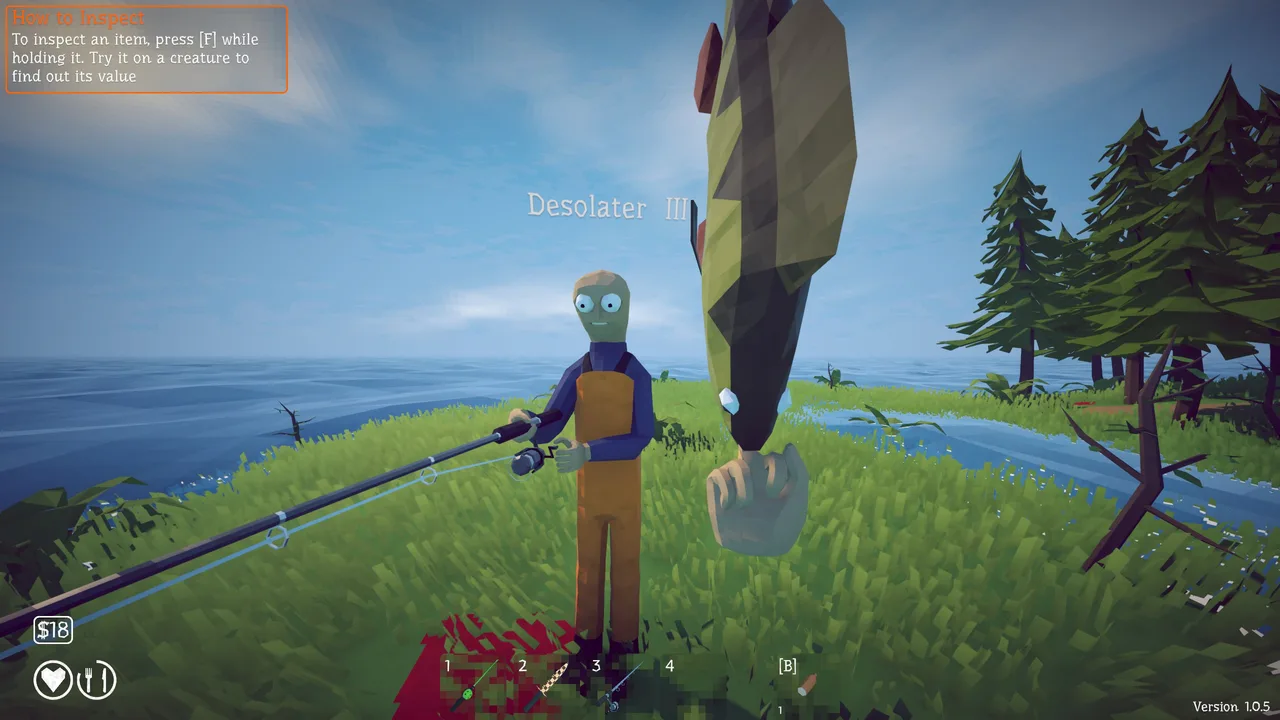
Fishing fills your inventory; selling fills your wallet. The real loop is catch → kill → increase value → sell → upgrade → quest. Every system you unlock (trick shots, cooking) exists to inflate step three. Players who treat this like a fishing simulator earn a fraction of the money per hour.
2. Buy the Basic Rod for $3 and Move On
The starter rod costs almost nothing and catches almost nothing — that is fine. Small shallow-water species die to your bare fists, sell consistently, and fund everything that matters. Do not chase expensive rods before you have a weapon; better bait matters more than better rods early.
3. Feed the Lighthouse Keeper Everything
Clams thrown to the keeper are your first income. Later, hand-ins drive progression entirely: he converts quest items into boat keys. Any NPC holding a quest marker is worth talking to between catches.
4. Sharpening Is the Cheapest Damage in the Game
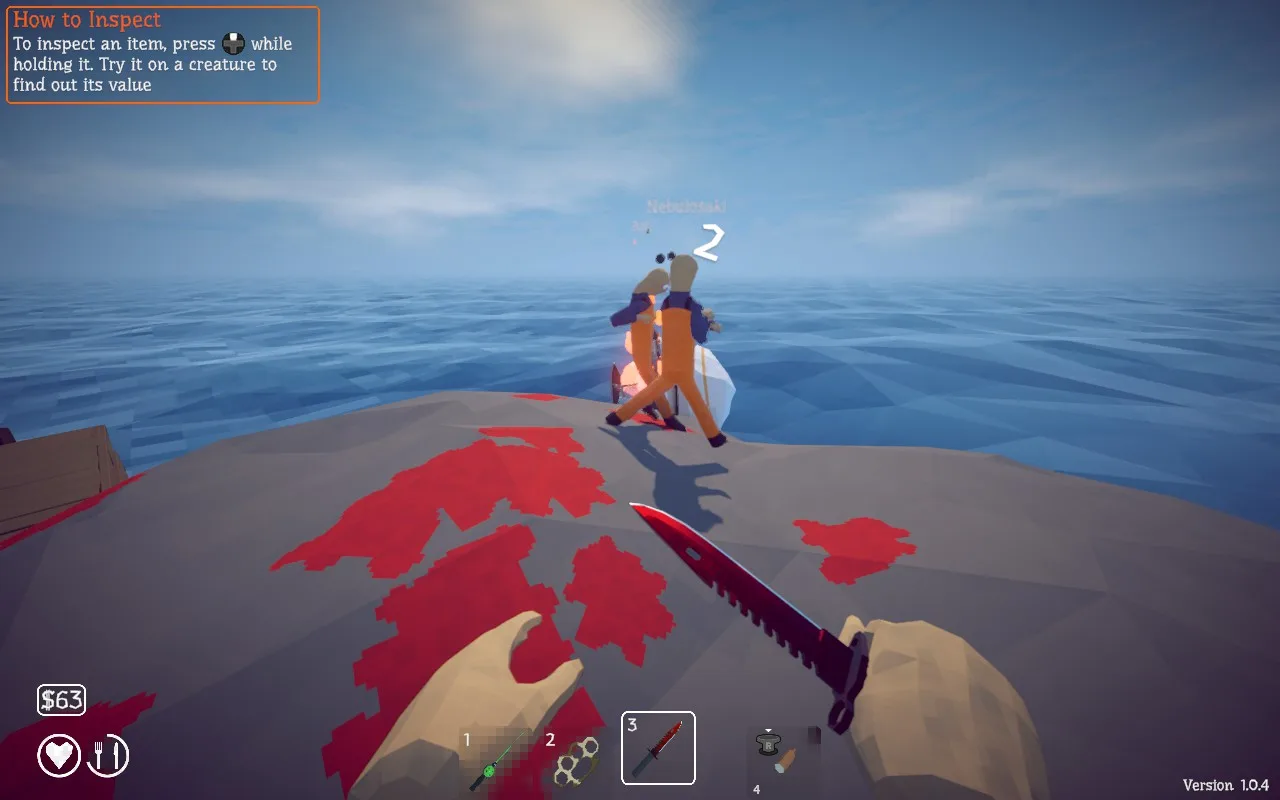
The knife costs $45 at the Island 1 shop, and the first three anvil upgrades ($14 / $28 / $36) raise it from 16 to 22 damage — about $123 all-in for a weapon that carries the entire first island. Compare that to guns: the pistol alone costs $50 and its base 25 damage per shot is nowhere near a fully sharpened knife's output. Melee carries Island 1 completely — and the first boss it carries is the Spider Crab, which folds to three sharpening cycles without a single bullet.
Brass knuckles (~$24) work too and free your inventory slot — the knife is disposable and can be sold before you sail if cash is tight.
5. Bosses Have an Escape Timer
Every boss health pool has a white bar underneath it. When it drains, the boss leaves and you redo the summon sequence. Learn each fight's punish window fast — hesitation wastes more time than damage does.
6. Never Sell Uniquely Named Drops
Shells, tails, heads, skeletons — if it has a proper noun, it is probably a quest object. New islands unlock by handing boss trophies to specific NPCs, not just by killing bosses. Sold the wrong item? You are re-farming the boss.
This is the single most common progression breaker in How to Fish. Hold every unique drop until its NPC takes it.
7. The Radar Costs $10 — Buy It Immediately
The radar sits at the Lighthouse for $10 and turns NPC coordinates into actual destinations. Without it, coordinates are dead weight. Later boat upgrades mount it permanently so you stop equipping it manually every sail.
8. Skip the Pistol Entirely
$50 for a gun whose base 25 damage per shot trails a fully sharpened knife is a trap purchase on any normal run — and even its fully upgraded form (160 damage across 13 paid tiers) arrives far too late to matter. Save toward the Shotgun at $150 instead: it starts at 3 damage per pellet but fires a spread that makes the Giant Piranha fight trivial rather than tedious. If you already bought one, do not double down on its damage ladder — the upgrade priority guide explains why the top tier of any weapon costs more than a better gun.
9. Guns Open Up on Island 2, Not Before
Island 1 has no gun shop. Plan around melee until the Forest, where the real arsenal unlocks: Shotgun $150, then SMG $650 on Island 3, Sniper Rifle on Island 4, and the $20,000 Assault Rifle for the endgame whale.
10. Recoil Attachments Are Near-Mandatory
Bare automatics spray wildly. Before any boss fight with the SMG or Assault Rifle, fit a compensator or suppressor — four attachment categories exist, and stability ones change boss fights more than raw damage does.
11. Trick Shots Are a Money System, Not a Flex
Mid-air kills and multi-kills multiply the value of what you sell. The Sniper Rifle has the largest trick-shot multipliers, but even shotgun flips pay. Practice on small catches before you need the skill on a boss.
12. Cook Before You Sell
Cooking is not a rounding error — it is a hard multiplier: raw fish sells at 1.0x value, properly cooked at exactly 1.5x, burnt at a humiliating 0.1x. Every catch also spawns with a hidden weight roll between 0.25x and 1.75x of its base weight, and the sale price scales with that roll. Raw selling is leaving money on the table from Island 3 onward. The full cooking guide covers the parts the game never explains — the grill's tick rate, why two identical fish sell for different money, and the fact that weapons and tools also pick up a cooked state in water.
Early-Game Fish Prices
| Fish | Base sell value | Base weight |
|---|---|---|
| Clam | $1 | 0.05 kg |
| Brown Crab | $3 | 2 kg |
| Seagull | $5 | 1.5 kg |
| Cod | $10 | 4 kg |
| Goldfish | $24 | 0.1 kg |
Remember the two multipliers on top: a good weight roll can triple these numbers before cooking doubles them again — which is why one lucky Goldfish can out-earn a whole bucket of clams.
13. Dynamite Is Lazy and Effective
For $25, dynamite clears water without aim or patience. It is not optimal play, but as a money tool for clustered shallows — or an emergency boss phase-skipper — it earns its price back fast per Destructoid's item guide.
14. Weapons Before Boat, Always
A faster boat feels good. A gun that kills what you hook pays rent. Every economy guide converges on the same order: rod → knife → radar → shotgun → ammo → then engine upgrades.
15. Co-op Money Is Shared Money
Lobbies hold up to eight players since patch 1.0.4 doubled the original four-player cap, and every purchase comes out of one shared wallet. Agree on purchase priorities before someone buys a pistol out of boredom. One player farming lures while another rushes weapon upgrades is a legitimate speedrun strategy — uncoordinated buying is not.
Official source: How to Fish supports online co-op with full controller support per the official Steam store page — lobbies started at 4 players and patch 1.0.4 raised them to 8, documented on the official Steam news hub. Launch coverage confirms over a million copies sold in two days (Dot Esports), and the live build history sits on SteamDB.
Your First Hour, Step by Step
Everything above compresses into one opening route:
- Talk to the keeper, eat a clam, throw clams until he pays you
- Buy the Basic Fishing Rod ($3), catch shallow species, punch them, sell
- Buy a knife; sharpen twice at the anvil ($14 + $28) when affordable
- Switch to Hotdog Lures ($1) and target bigger bodies for better margins
- Buy the Radar ($10) — do not delay this past your first boat ride
- Take the Beer Can quest, summon the Spider Crab, win with sidestep-punish loops
- Hand in for the boat keys; buy the Shotgun ($150) the moment you land on Forest
That route touches every system once, wastes nothing, and leaves you ahead of the curve instead of selling gear to afford ammo.
What Most Beginners Get Wrong
The failure modes are consistent enough to predict: someone buys the pistol because a number went up, someone sells a shell labeled like a treasure, someone upgrades boat speed before owning a real weapon, and someone in co-op spends the shared wallet without asking. Every tip above exists because a thousand players hit exactly one of these walls.
The game forgives all of it — bosses re-summon, islands stay unlocked, dynamite fixes bad afternoons — but the first ten hours feel twice as long when you learn each lesson the expensive way.
The Five Things That Cost New Players the Most Money
Every one of these is a purchase the game lets you make and never warns you about. Ranked by how much they actually drain:
1. The Pistol at $50. Its base 25 damage per shot trails a fully sharpened knife (22 damage) on a per-swing basis once you account for reload time, and the $50 is a third of the Shotgun that actually solves Island 2. The weapon comparison runs the full ladder if you want the numbers side by side.
2. The last tier of any weapon upgrade. The Assault Rifle goes from 90 to 95 damage for $5,125, then 95 to 100 for $5,800 — $10,925 for ten points of damage, on a gun that already costs $20,000. The Pistol is worse: its final step alone is $9,100 for 30 damage. Upgrade costs are non-linear by design, which is why the money guide tells you to stop one tier short until the story is finished.
3. A $280 boss lure for a $300 drop. The Standard Boss Lure forces a 100% Blue Shark spawn, and the shark's base value is $300 — before the hidden weight roll, which can land as low as 0.25x. Every boss lure is also consumed 100% of the time you cast it, unlike ordinary lures that survive 60–80% of retrieves. A poor roll means you paid $280 to lose money. Boss lures are Fishipedia purchases, not income.
4. The $40 Beginner Boss Lure. It is a coin flip between two full mini-boss fights: Sunfish at 1,500 HP with a $50 base value, or The Old Pike at 1,000 HP with an $80 base value. Neither pays for the bait, and a new player without a real gun can burn an entire ammo load on one summon — then get the other half of the coin flip on the next $40 cast.
5. The casino. Roulette is negative expected value on both bets: red or black pays 2x on 18 of 37 pockets (about 48.6%, expected return 0.973), while green pays 35x on a single pocket (about 2.7%, expected return 0.946). There is no pity system and no house edge softening — the casino guide covers the one achievement that justifies gambling at all, and it recommends using fish you have already written off.
FAQ
What should I buy first in How to Fish?
Basic Fishing Rod ($3), then a knife and sharpenings, then the Radar ($10), then the Shotgun ($150). That order funds itself the whole way.
Can you play How to Fish solo?
Yes — single-player works fine and several guides were written entirely solo. Co-op just splits the grind across up to four players.
Why is my money disappearing in co-op?
All purchases come from the shared wallet. Set buy priorities with your crew before the shop run.
More How to Fish Guides
How to Fish casino guide: the Island 4 Lucky Bait roulette, why green 35x returns less than red 2x, the All In achievement, and Reel of Fortune skins.
Cooking in How to Fish multiplies an item value by 1.5x and burning it cuts value to 0.1x. Grill unlock, the full formula, magma cooking and burnt sales.
How to make money fast in How to Fish: early clam loops, the shotgun pipeline, cooking multipliers, dynamite farming and the $20,000 rifle fund.
How to Fish upgrade priority: weapon damage first, then inventory slots and the $10 radar, with real tier costs from the game files and what to skip.
Lighthouse Island guide: clam economy, the $3 rod, knife sharpening prices, the Beer Can quest and beating the Spider Crab for boat keys.
How to beat How to Fish's final boss — Magma Whale aka Mutated Bowhead — Scientist quest, $20,000 AR loadout and volcano strategy.
How to beat the Pufferfish: shark feast and endangered fish quests, carrot bait trigger, and an SMG strategy for the tankiest boss.
The radar in How to Fish explained: the $10 Lighthouse pickup most players miss, reading NPC coordinates, permanent mounting and sailing between islands.